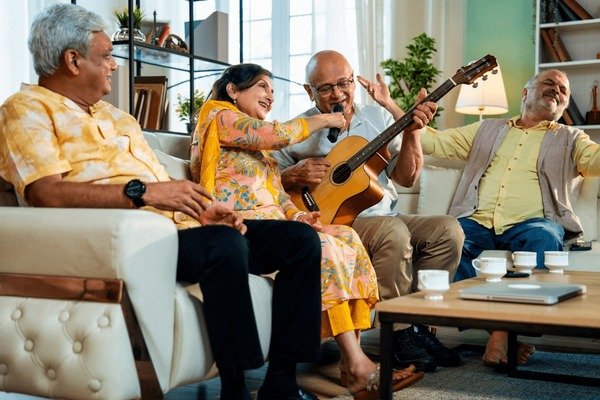

The most common question we get after "Are you free on the 14th?" is "Do we need one musician or three?" The honest answer: it depends on three things, your guest count, your space and the feel you want.
Start with your guest count
Guest count is the simplest way to narrow it down. A solo set fills a living room beautifully, but a 150-guest lawn needs more presence than one voice and one guitar can give.
- Up to 40 guests: Solo is usually perfect. Intimate, personal and easy to fit anywhere.
- 40 to 120 guests: Duo adds percussion or keys for a fuller sound that carries across a bigger room.
- 120+ guests: Trio gives the full band feel for sangeets, receptions and corporate nights.
Then look at your space
A trio in a small apartment can feel crowded, and a solo singer on a large terrace can get lost. As a rule of thumb, a solo set needs about 2×2 metres, a duo 3×2 and a trio 4×3, plus a power point nearby.
The best format is the one where your guests can still talk to each other between songs.
Quick comparison
| Solo | Duo | Trio | |
|---|---|---|---|
| Line-up | Vocals + guitar | + percussion or keys | + percussion + keys/violin |
| Guests | Up to 40 | 40–120 | 120+ |
| Space | 2×2 m | 3×2 m | 4×3 m |
| Best for | House parties, dinners | Birthdays, family events | Sangeet, corporate |
| From | ₹15,000 | ₹28,000 | ₹45,000 |
Finally, the feel you want
Solo is the most intimate: think candle-lit dinner or a living-room sing-along. Duo is the sweet spot for most celebrations, with enough rhythm to lift the energy without overpowering conversation. Trio is a proper show, ideal when you want people up and dancing.
Still not sure?
Send us your date, guest count and venue. We'll recommend a format in one message, no obligation.
Ask on WhatsApp